

5G marks the next phase of global digital transformation, enabling faster speeds, lower latency, and support for advanced applications such as automation and real-time communication.
Global adoption continues to accelerate as telecom providers expand networks and consumers upgrade devices.
Africa presents a different pattern, where network rollout progresses faster than actual usage.
A clear gap exists between availability and adoption.
Current State of 5G in Africa
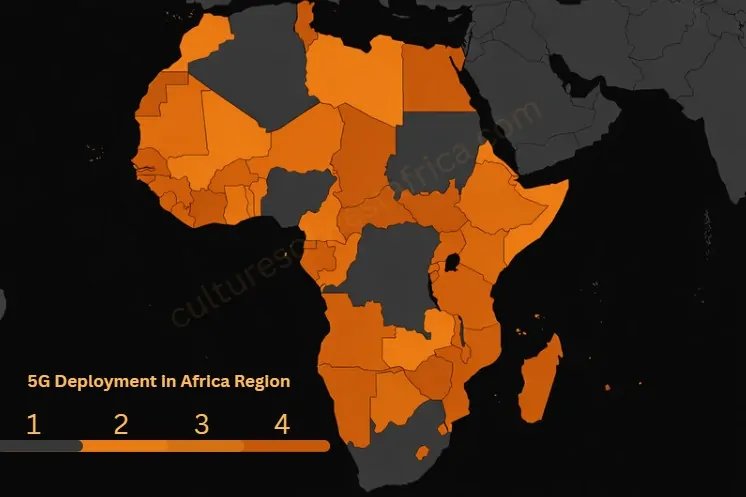
Early-stage deployment across Africa shows clear momentum, yet progress remains uneven across regions and income groups.
Network rollout continues to expand, but access and usage remain limited.
A closer look at both coverage and penetration reveals a growing imbalance between infrastructure availability and actual connectivity.
Coverage Expansion
Telecom operators across Africa continue investing in next-generation infrastructure to support rising demand for mobile data and digital services.
Rapid population growth, combined with a predominantly young population, increases pressure on networks and accelerates the need for faster and more reliable connectivity.
Urban centers receive most of this investment due to higher population density and stronger commercial returns.
Several leading markets have already introduced 5G services, signaling early progress in deployment.
Notable developments include:
- South Africa launched 5G services through major operators, focusing on metropolitan areas
- Nigeria introduced 5G with gradual expansion plans targeting key cities
- Kenya initiated rollout with emphasis on high-demand urban zones
Growth projections reinforce the pace of expansion. 5G remains the fastest-growing mobile technology globally, with expected annual growth of about 59%.
Expansion efforts remain concentrated in economically active regions, where infrastructure investment yields quicker returns.
Network densification in cities continues to improve coverage quality, while rural areas remain largely underserved.
Limited Access and Penetration
Despite visible infrastructure progress, access to 5G remains extremely limited.
A large portion of the population still lacks the ability to connect to advanced networks due to geographic and economic constraints.
The distribution of coverage reflects a strong urban bias, leaving rural communities with minimal or no access.
Current access levels remain low, as shown by the following figures:
- Only about 1% to 2% of the population has access to 5G networks
- Rural regions account for a significant share of unconnected users
- Sub-Saharan Africa continues to record the highest levels of household disconnection
Uneven infrastructure distribution creates a situation where network rollout does not translate into widespread accessibility.
Many households remain excluded from even basic mobile broadband services, limiting the overall impact of 5G expansion.
The Usage Gap
View this post on Instagram
A major challenge lies in the gap between network availability and actual usage.
Many individuals live within coverage areas but do not use mobile internet services.
This gap has become more pronounced as infrastructure expands faster than user adoption.
Network usage patterns further reinforce this issue. Distribution across technologies shows continued reliance on older systems:
- Around 50% of connections remain on 3G
- Approximately 33% use 4G
- 5G accounts for only a small fraction of total connections
Infrastructure alone does not guarantee adoption. Economic, technological, and social barriers continue to prevent users from transitioning to newer networks.
As a result, increased coverage does not translate into proportional growth in active users.
Key Barriers to 5G Adoption

Multiple structural and economic factors limit the transition to 5G across African markets.
Barriers exist at both the consumer and system level, slowing adoption despite ongoing investment in infrastructure.
Economic Constraints
Affordability remains the most immediate barrier to adoption. High prices for 5G-compatible devices restrict access for a large portion of the population.
Income levels across many countries remain low relative to the cost of smartphones and mobile data.
Key affordability challenges include:
- High upfront cost of 5G-enabled smartphones
- Limited purchasing power among large segments of the population
- Data costs that remain significant despite gradual reductions
Access to more affordable technology options, such as refurbished laptops from PCLiquidations, can help reduce the cost barrier and expand digital access for underserved populations.
Even in markets where data pricing has improved, total cost of ownership continues to limit adoption.
Financial constraints prevent many users from upgrading devices or subscribing to higher-tier data plans.
Infrastructure Challenges
Network performance depends heavily on supporting infrastructure, which remains underdeveloped in many regions.
Limited fiber backhaul reduces network efficiency and restricts expansion capacity.
Gaps in electricity supply and physical infrastructure further complicate deployment.
Weak infrastructure reduces both coverage quality and reliability, limiting user experience and discouraging adoption.
Device Ecosystem Limitations
Availability and adoption of compatible devices play a central role in 5G uptake.
Smartphone penetration across Africa remains lower than global averages, slowing transition to advanced networks.
Many users continue to rely on older technologies due to cost and accessibility.
Limited access to affordable 5G devices delays mass adoption and prolongs dependence on legacy networks.
Spectrum and Regulatory Issues

Regulatory frameworks vary significantly across countries, creating inconsistencies in deployment conditions.
Spectrum allocation has improved in some markets, yet progress remains uneven. High licensing fees increase costs for operators and slow rollout.
Regulatory challenges include:
- High spectrum costs that limit operator investment capacity
- Fragmented policies across national markets
- Delays in spectrum release in certain regions
Inconsistent regulation creates uncertainty and slows network expansion efforts.
Digital Literacy and Demand
Consumer demand for 5G remains limited due to low awareness of its benefits.
Many users prioritize essential services such as voice communication and basic internet access.
Advanced capabilities associated with 5G do not yet align with immediate user needs.
Demand-related factors include:
- Limited awareness of 5G capabilities among consumers
- Preference for affordable and basic connectivity services
- Lack of widely adopted applications requiring high-speed connectivity
Without strong demand, incentives to upgrade devices or data plans remain low, slowing adoption further.
Socioeconomic and Structural Factors
Broader socioeconomic conditions continue to shape digital adoption across Africa.
Large rural populations reduce immediate demand for high-speed connectivity, as many communities still lack access to basic services.
Economic inequality further reinforces disparities in access and usage.
Even in areas where mobile broadband coverage reaches about 85% of the population, active usage remains limited.
Access alone does not ensure participation in digital services, as affordability and relevance play a central role.
Role of Telecom Operators and Governments

Progress in adoption depends heavily on coordination between telecom operators and public institutions.
Both groups play essential roles in expanding infrastructure and improving accessibility.
Operator Strategies
Telecom operators focus on areas that generate higher returns, leading to the concentration of 5G rollout in urban centers. Cities and economically active regions receive priority due to stronger demand and better infrastructure.
Fixed Wireless Access is gaining traction as a practical solution for expanding connectivity. Key advantages include:
Lower deployment costs compared to traditional wired infrastructure
Faster rollout in underserved and rural areas
Ability to deliver broadband access without extensive physical networks
Such approaches help extend coverage but still require supporting infrastructure and affordable pricing to drive adoption.
Government Policies
Public policy plays a critical role in shaping the pace and scale of adoption. Supportive regulatory frameworks can reduce barriers and encourage investment.
Governments can influence both supply and demand through targeted initiatives.
Important policy actions include:
- Affordable spectrum allocation to reduce operator costs
- Incentives for infrastructure development in underserved regions
- Public-private partnerships to accelerate deployment
Effective regulation can create conditions that support broader access and increased adoption.
Opportunities for Accelerating Adoption
Future growth depends on improvements in affordability, infrastructure, and demand.
Several trends indicate potential for increased adoption over time.
Declining device costs will make 5G-capable smartphones more accessible. At the same time, smartphone penetration is expected to grow significantly, adding hundreds of millions of users by 2030.
Expanding digital ecosystems will further increase demand for connectivity.
Infrastructure development will also play a critical role. Fixed Wireless Access offers a scalable solution for rural connectivity, while regional cooperation can support investment and knowledge sharing.
Combined efforts across public and private sectors can accelerate adoption and reduce the usage gap.
Summary
A clear disconnect exists between 5G availability and actual usage across Africa.
Coverage continues to expand rapidly, yet adoption remains limited due to affordability constraints, infrastructure gaps, and low demand.
Closing the usage gap holds significant potential to boost GDP, attract foreign investment, and accelerate digital transformation.
Progress depends on more than network expansion, requiring inclusive access, improved affordability, and development of services that encourage active use.