

People love asking which West African language is easiest, like there is a single clean answer waiting at the end of the road. There is not.
Ease lives at the intersection of who you are, what you already speak, what your ear can pick up, and where you will actually use the language. A language that feels friendly to one learner can feel stubborn to another.
A more honest way to think about “easy” is practical momentum.
Can you start using the language early. Can you hear it often. Can you read it without fighting the writing system. Can you find enough beginner material to stay consistent for the first 3 months.
When those pieces line up, learning stops feeling heavy and starts feeling doable.
Today, we prepared a beginner-focused guide to West African languages that tend to offer smoother starts in real life, along with why they often feel that way.
A Simple Beginner Ease Scorecard
Before committing to a language, it helps to check a few practical boxes.
- Fast early comprehension due to English or French influence
- Pronunciation load that feels manageable to your ear
- Ability to read basic sentences within 2 to 3 weeks
- Structured beginner materials, not just phrase lists
- Real-world usefulness in your life or location
Languages that score well across most of these areas often feel easier, even if they are not “simple.”
Shortlist Of West African Languages That Often Feel Easier For Beginners
Some West African languages tend to feel more approachable at the beginner stage because their sound systems, writing conventions, and real-world usefulness line up well with how people actually learn in the first months.
1. Krio (Sierra Leone)
Krio is an English-lexifier creole and functions as a major bridge language in Sierra Leone. For English speakers, the early payoff is real. You recognize words quickly, even when grammar works differently. That sense of partial comprehension shows up fast and keeps motivation alive.
Speaker Reality and Usefulness
APiCS reports approximately 350,000 native speakers and roughly 4 million users as a lingua franca.
Translators without Borders also describes Krio as widely used across ethnic lines, while being the first language for a smaller share of the population.
Beginner-Friendly Traits
- Immediate vocabulary overlap for English speakers
- High day-to-day utility across Sierra Leone
- Quick functional ability for basic conversation
Typical Early Friction
- Spelling varies across sources
- Familiar-looking words often sound different out loud
Best For
English speakers aiming for quick communication in travel, social settings, fieldwork, or heritage contexts.
2. Wolof (Senegal, The Gambia, Mauritania)

Wolof dominates daily life in Senegal and functions as a shared language across many communities. That constant exposure helps beginners because practice opportunities appear naturally.
One major advantage for beginners is that Wolof is widely described as non-tonal in modern reference work. For many learners, that removes a large early listening hurdle.
Beginner-Friendly Traits
- No tone system in the Niger-Congo sense
- Strong availability of structured materials, including Peace Corps manuals
- Growing digital presence following Google Translate’s 2024 expansion
Typical Early Friction
- Grammar structures that do not map neatly to English or French
- Pronoun and focus systems that feel unfamiliar at first
Best For
Learners focused on Senegal or The Gambia, urban communication, music and media, or field research.
3. Bambara (Bamana) And Related Trade Varieties Such As Dyula
Bambara functions as a major lingua franca in Mali and beyond. Britannica’s coverage of Mande languages consistently highlights its regional reach. That reach means beginners can use it widely rather than only within one community.
Beginner-Friendly Traits
- Extensive beginner materials, including Peace Corps training manuals
- High real-world usefulness in Mali and trade corridors
- Improving digital visibility linked to language technology expansion
Typical Early Friction
- Tone plays a real role, requiring careful listening
- Grammar and word order differ from European languages
Best For
Francophone West Africa travel, humanitarian work, and learners who want strong practical coverage.
4. Hausa
Hausa’s size changes the learning experience. Massive media presence, radio, television, and online content provide steady input. High exposure often smooths learning more than structural simplicity.
Beginner-Friendly Traits
- Clear grammatical descriptions in reference works
- Strong ecosystem of modern learning tools, including platforms like Memrise
- Huge second-language speaker base
Typical Early Friction
- Tone is unmarked in standard spelling
- Plurals and morphology become noticeable quickly
Best For
Northern Nigeria, Niger, Sahel travel, journalism, and research contexts.
5. Akan (Twi-Fante Cluster)
Akan varieties dominate daily interaction and trade in much of Ghana. Britannica notes that Akan languages have millions of speakers and play major roles in commerce and social life.
Beginner-Friendly Traits
- High everyday usefulness
- More learning materials than many expect
- Active second-language use
Typical Early Friction
- Tone is fundamental and affects meaning
- Fast natural speech can overwhelm beginners
Best For
Ghana-based travel, family ties, community work, and professional settings.
6. Yoruba
Yoruba’s cultural footprint is enormous. Music, film, religion, and diaspora connections pull learners in. Strong motivation often offsets difficulty because learners stay consistent.
Beginner-Friendly Traits
- Latin-based orthography with tone marks
- Large community producing media and learning content
Typical Early Friction
- Tone is central and tone marks are often omitted in casual writing
- Audio support becomes essential early
Best For
Learners with cultural or heritage motivation and a plan for daily listening.
7. Fulfulde, Pulaar, Pular (Fula Continuum)
Fulfulde and related varieties stretch across West and Central Africa. Institutional descriptions frequently note its non-tonal nature, which helps early pronunciation.
Beginner-Friendly Traits
- Non-tonal characterization
- Strong Peace Corps materials for Pulaar and related varieties
Typical Early Friction
- Noun class systems and agreement patterns
- Real dialect variation across regions
Best For
Senegal River Valley, Guinea, Sahel regions, and learners seeking broad geographic reach.
Quick Comparison Table For Beginners
| Language | Primary Use Areas | Tone Factor | Beginner Advantage | Common Frustration | First Goal |
| Krio | Sierra Leone | Low barrier for English speakers | Fast comprehension | Spelling variation | Everyday conversation |
| Wolof | Senegal, The Gambia | Non-tonal | Lighter pronunciation load | Grammar patterns | Daily interactions |
| Bambara, Dyula | Mali, trade corridors | Tone relevant | Strong materials | Listening precision | Survival communication |
| Hausa | Sahel, Northern Nigeria | Tone unmarked | Huge resources | Plurals, tone | Practical interviews |
| Akan | Ghana | Tonal | High utility | Tone and speed | Social basics |
| Yoruba | Nigeria, Benin | Tonal with diacritics | Cultural content | Tone omission | Listening-driven growth |
| Fulfulde, Pulaar | Wide regional spread | Often non-tonal | Geographic reach | Noun classes | Daily task phrases |
What Makes A West African Language Feel Easier At The Beginner Stage

If English is your main language, English-lexifier creoles can give a fast early boost. Familiar-looking words and sentence patterns reduce the shock of the first weeks.
If French is already in your head, Francophone West Africa often offers more structured learning materials, plus loanwords and shared vocabulary in daily speech.
Neither path is better. They simply change what feels “easy” at the beginning.
Tone Adds Work, But Rarely Blocks Progress
Many West African languages use tone, pitch differences that change meaning. That adds listening and pronunciation work, especially early on.
Yoruba uses diacritics to mark tone in its standard orthography, even if everyday writing often drops them. Akan varieties treat tone as a core part of how meaning works. Hausa is also described as a tone language, though tone usually goes unmarked in normal spelling.
Tone matters most for short words and listening accuracy. Perfection is not required in week one. What matters is steady exposure and a willingness to copy sounds rather than overthink them.
Writing Systems Can Speed Confidence
Many major West African languages use Latin-based spelling systems in official contexts. That lowers the barrier to reading simple sentences early.
Some languages also have additional scripts such as Ajami, N’Ko, or Adlam. Beginners can usually start with Latin orthography and add other scripts later if needed.
Resources Often Beat Structural Simplicity
A language with strong audio, dictionaries, courses, and a large second-language speaker base can feel easier than a language with fewer materials, even if the second language has simpler grammar on paper.
One signal of growing support is language technology. Google Translate’s 2024 expansion added 110 new languages, including several West African and trade languages. That matters because it increases typed examples, searchable phrases, and beginner-friendly lookup habits.
Picking The Right “Easy” Language Based On Your Goal
Choosing an “easy” West African language makes the most sense once your goal is clear, because travel, work, family ties, and media use all reward different kinds of early progress.
Fastest Win For English Speakers
- Krio
- Wolof
- Hausa, because of resources rather than simplicity
Practical Reach In Francophone West Africa
- Wolof in Senegal
- Bambara or Dyula for trade and regional communication
Ghana-Specific Focus
Akan varieties often make the most sense due to constant exposure, even with tone.
A Realistic 30-Day Starter Plan For Most West African Languages
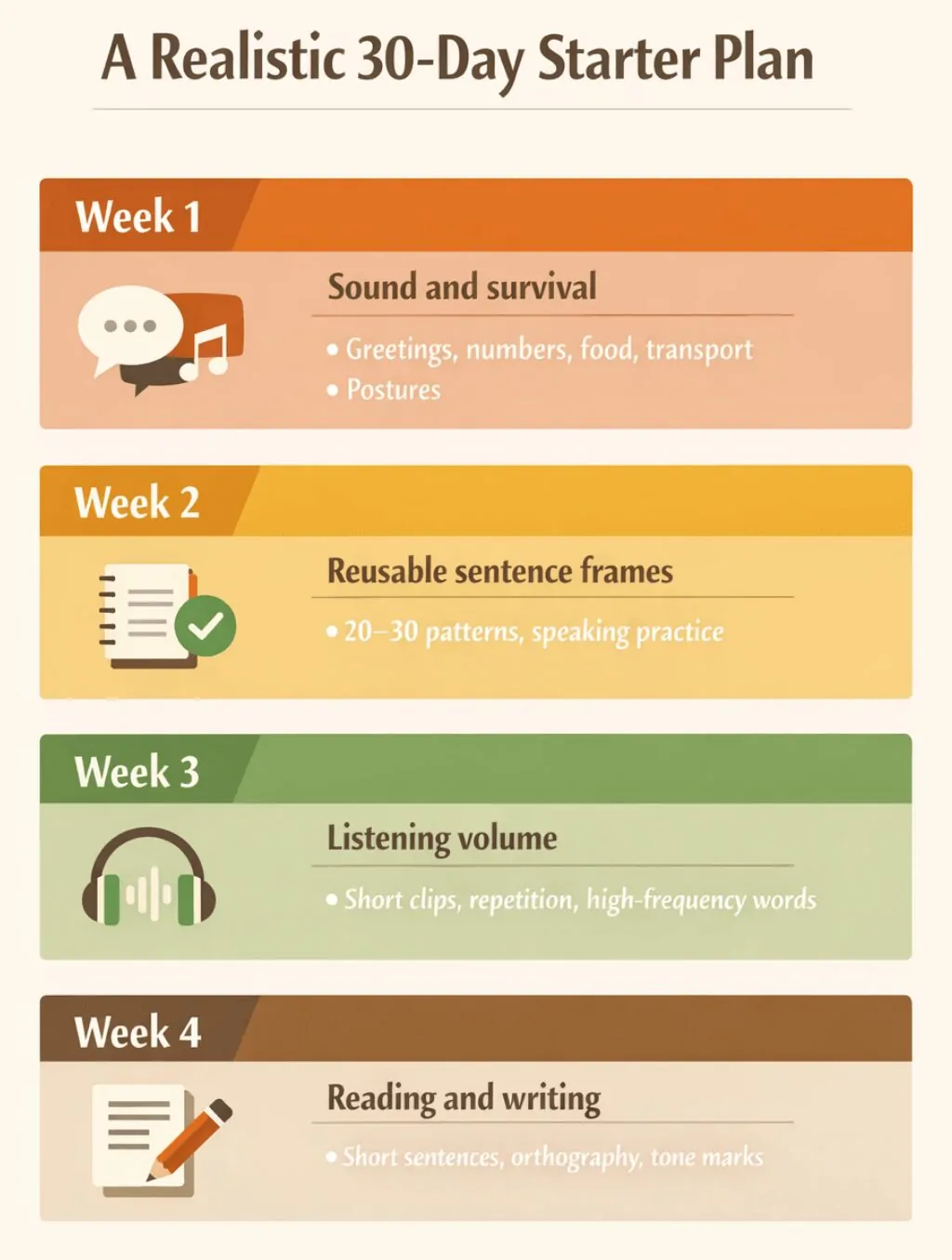
Learning a West African language sticks better when the first month has a clear shape, realistic expectations, and daily habits that prioritize sound, repetition, and usable speech over theory.
Week 1: Sound And Survival
Focus on greetings, introductions, politeness, numbers 1 to 20, directions, food, and transport. Keep grammar on the sidelines. Copy rhythm and pronunciation.
Week 2: Reusable Sentence Frames
Memorize 20 to 30 sentence patterns that accept different nouns and verbs. Record yourself. Compare with native audio.
Week 3: Listening Volume
Use short clips and repeat them heavily. Two minutes, many times. Keep a list of high-frequency words.
Week 4: Reading And Writing Short Lines
Learn orthographic markers early, including tone marks where used. Write 5 short sentences a day and check them against a structured course or grammar reference.
Peace Corps manuals work especially well for this approach. They were built for rapid functional ability and exist for languages like Wolof, Bambara, and Pulaar.
Final Thoughts
Ease in language learning rarely comes from grammar charts. It comes from early wins, steady exposure, and a reason to keep showing up.
West Africa offers languages that reward beginners quickly when the match is right. Pick the language that fits your ear, your goals, and your daily life, then give it consistent time. Momentum does the rest.